
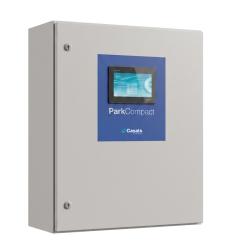
GENERAL DESCRIPTION PARKCOMPACT is Casals' car park ventilation control system designed to allow automatic and manual management of several fans, efficiently adapting to air quality (CO) and safety needs. It is the intermediate solution within the ventilation control family, offering an optimal balance between functionality, flexibility, and cost. It is positioned between the advanced PARKGUARD and the basic PARKDIRECT, making it the ideal choice for medium-sized car parks.
SYSTEM ARCHITECTURE The system is based on an industrial PLC that centralizes and controls the operation of the fans based on external signals and optimized internal programming. It allows the management of 3 to 7 independent motors and is compatible with dual-speed motors (low/high) for precise airflow control.
CONSTRUCTION AND CONTROL CHARACTERISTICS PARKCOMPACT integrates a robust electrical panel that includes a touchscreen for simple interaction, individual contactors per motor, and complete thermal and electrical protections, guaranteeing the integrity of the installation at all times.
INTEGRATION AND COMMUNICATIONS The system is designed for seamless integration into the car park environment, allowing connection with:
CO detectors and control units (CO MASTER type).
Fire detection system signals.
Fireman’s panel for priority command.
OPERATION Its operating logic follows the same safety principles as higher-level systems, allowing work in the following modes:
Automatic Mode: Activation of fans according to demand.
Low CO signal → Low speed.
High CO signal → High speed.
Execution of hourly programming and response to fire signal.
Manual Mode: Allows individual activation of each motor from the interface, facilitating maintenance tasks, system tests, or specific ventilation. The system strictly manages operation priorities: first the COMBATOR fireman's panel (highest priority), followed by the fire signal, and finally, the detected CO levels.
SUPERVISION AND VENTILATION TYPOLOGY PARKCOMPACT allows clear supervision through the visualization of the status of each motor (operation, active speed, or thermal fault) and the adjustment of operating times. It is capable of controlling complete systems that include extractors (exhaust), air supply units (supply), and induction fans (Jet fans).
